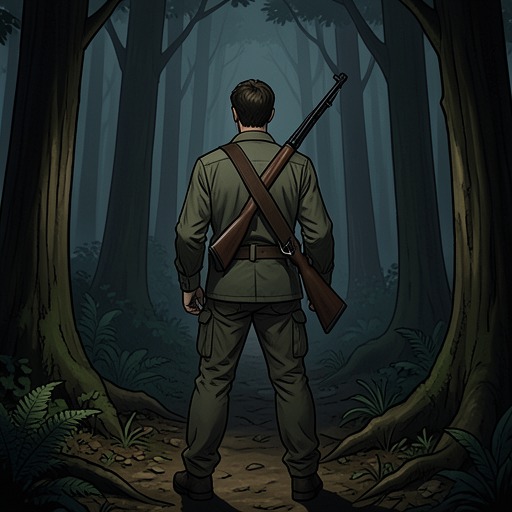
Mowat’s first mistaken identification of a husky team as a wolf pack
Never Cry WolfFarley Mowat’s first apparent contact with the Wolves he had come to study is a comic reversal with practical consequences: the intimidating pack that seems to close in on him is Mike and his fourteen Husky dogs. The mistake ends his isolation on the lake and leads him to the cabin that becomes his base camp. No wolf is present, but the encounter turns a frightening misidentification into the beginning of a working relationship—and exposes how easily expectation can shape what an observer thinks he sees and hears.
Dusk and the Expected Pack
The episode begins after Mowat has finished trying to make contact by radio. The battery is good for only six hours’ use, and the only station he has managed to raise is broadcasting light music from Moscow. As darkness gathers, the surrounding hills seem to close in. He has seen no wolf, but the possibility occupies his attention; when movement flickers near the valley mouth, he reads it through that expectation.
Then he hears a sound he recognizes from cowboy films, although never before from the wild: a pack howling in full cry, apparently in his direction. For a moment, the research problem seems solved. Yet the apparent solution immediately produces another danger. Mowat has only six rounds in his pistol and cannot remember where he put the reserve ammunition. His reading tells him that a pack may contain four to forty animals; judging by the volume of the cries, he imagines that this one may number closer to four hundred. The gap between the numbers he knows and the number he fears gives the scene its anxious, self-mocking edge.
The night is too dark for him to see the approaching animals clearly or assess their behavior. He retreats beneath his upturned canoe, hoping the concealment will keep his presence from changing how the animals act. His reasoning is scientific—an observer should not disturb the subject—but the precarious shelter also protects him from a threat he cannot evaluate. Unable to see, he follows the approach by sound: the pack sweeps around his equipment and charges the canoe.
The Sounds Under the Canoe
A tumult of howls, barks, and yelps nearly deafens Mowat. In the confusion, he imagines a deep, almost human voice rising above the noise and internally renders its complaint as “FURCRISAKESTOPYOUGODAMNSONSABITCHES!” Scuffling follows, then pained yelping, and at last a sudden silence. The sequence makes his fear comic without making it unreal: he is alone, in the dark, beneath a fragile canoe, with no clear view of whatever is moving around him.
Mowat knows that his training should help him draw accurate conclusions from natural evidence, but here he admits he lacks the data. He cautiously peers through the narrow gap between the canoe’s gunwale and the ice. At first he sees only wolf feet—scores of them, as the scene presents them to his restricted view. Then he notices a different pair: feet that could belong to no wolf. With that clue, his powers of deduction return. He lifts the canoe and looks up into the bewildered, apprehensive face of a young man dressed in caribou furs.
The apparent pack is Mike’s dog team. Fourteen large, formidable Husky dogs are scattered around him, staring at Mowat with suspicion; not one bona fide wolf is in sight. The discovery punctures the imagined encounter at its most dramatic point. The sounds and movement were real, but Mowat’s identification of them was wrong. His first approach to the study species has been an approach to domestic dogs instead.
From Mistaken Contact to Base Camp
Mowat is disappointed that his first encounter with Wolves has turned out to be an encounter with nonwolves, but the meeting offers an unexpected practical advantage. Mike is a trapper of mixed Inuit and white parentage with a cabin a few miles away. Apart from a small community of Eskimos, including his mother’s family, living seventy miles north, Mike is the only other human inhabitant in an area of about ten thousand square miles. Mowat sees the isolation as favorable to his research, since human intrusions are unlikely to disrupt his study.
Mike, however, has reason to distrust the unexplained arrival. At eighteen, he has never known an aircraft to land in his part of the Keewatin Barren Lands and has seen only two or three planes, high overhead. He has difficulty believing that an aircraft he neither saw nor heard has delivered Mowat and an immense pile of equipment onto the lake. His initial suspicion leans toward a supernatural explanation; what he has learned of Christianity from his white trader father has made him wary of the devil. For the first few days he keeps his distance and carries his 30–30 rifle in his hands. After Mowat introduces him to wolf-juice, Mike puts the rifle away, apparently deciding that, if Mowat is the devil, his blandishments are hard to resist.
That first night Mike leads Mowat to his cabin. It is a modest building of poles roofed with decaying caribou hides, but Mowat judges it suitable for his purposes. Authorized by the Department of Mines and Resources to hire local assistance, provided the expense stays within three dollars a month, he makes a deal: an official ten-dollar IOU covers three months’ accommodation as well as Mike’s work as guide and general factotum. Mowat recognizes that the payment is generous by the rates paid to Arctic residents by government agencies, missions, and trading companies. He justifies the expense by calculating that without Mike’s help his Department risks losing about four thousand dollars’ worth of equipment when the lake ice melts.
Mowat later suspects the bargain may have been one-sided and that Mike may not have fully understood its implications. Whatever its fairness, Mike supplies the dog team to move Mowat’s equipment and stores to the cabin. The initial false identification thus yields something the actual Wolves have not yet provided: a guide, a place to work, and help rescuing valuable supplies from the lake.
The Error’s Place in the Fieldwork
The encounter introduces a tension that remains central to Mowat’s fieldwork: observation depends on attention, but attention is never entirely separate from expectation. In the dark, he interprets a flicker as possible wolf movement, turns a howl into confirmation, and lets the noise swell into an imagined pack of hundreds. His later glance at a single pair of human feet corrects the whole construction. The error is not simply that he mistakes one kind of animal for another; it shows how little he can establish when sight is absent and fear supplies the missing evidence.
The meeting also changes the conditions of the research. Mowat had arrived with equipment and plans, but his studies depend on cooperation from the people who know the land and can help him function in it. Mike’s cabin, local knowledge, and dog team make extended fieldwork possible. The arrival that Mike initially treats with suspicion becomes a negotiated practical arrangement, though Mowat’s later doubts about the bargain keep that arrangement from appearing wholly uncomplicated.
Most importantly, the scene distinguishes an anticipated encounter from the sustained observation Mowat still has to earn. His first apparent success produces no wolf data at all; it instead brings him into contact with Mike and gives him a foothold in an immense, sparsely inhabited region. The noisy rush around the canoe ends not in a confrontation with the study animals but in a face-to-face meeting with a human neighbor. That reversal makes the episode both an opening mishap and the first workable step toward the research that follows.